Astrology has guided human life for thousands of years, offering insights into personality, destiny, and future events. However, not all astrology systems are the same. The two most popular systems—Vedic Astrology and Western Astrology—often confuse beginners.
While both aim to interpret celestial influences, they differ significantly in methods, calculations, and predictions.
In this blog, we’ll break down the key differences between Vedic and Western astrology, helping you understand which system aligns better with your needs.
What is Vedic Astrology?
Vedic astrology, also known as Jyotish Shastra, originated in ancient India and is deeply rooted in the Vedas.
Key Features of Vedic Astrology:
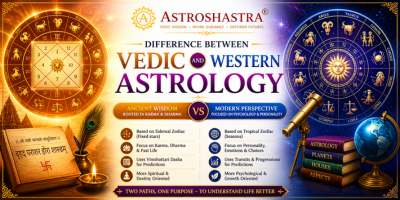
- Uses the Sidereal Zodiac (fixed zodiac)
- Focuses on karma and destiny
- Based on Nakshatras (lunar constellations)
- Includes Dasha system for timing life events
- Emphasizes spiritual growth and life purpose
Vedic astrology is often considered more predictive because it focuses on real-time planetary positions.
What is Western Astrology?
Western astrology developed in ancient Greece and evolved through European traditions.
Key Features of Western Astrology:
- Uses the Tropical Zodiac (season-based zodiac)
- Focuses on psychology and personality
- Relies heavily on Sun signs
- Emphasizes self-awareness and behavior patterns
Western astrology is widely popular for horoscopes and personality analysis.
Sidereal vs Tropical Zodiac: The Core Difference
The biggest difference lies in how zodiac signs are calculated.
Vedic Astrology (Sidereal Zodiac):
- Based on actual positions of constellations
- Adjusted using ayanamsa (precession correction)
- More astronomically aligned
Western Astrology (Tropical Zodiac):
- Based on Earth’s seasons
- Fixed starting point (Aries at spring equinox)
- Does not adjust for precession
Result: Your zodiac sign may differ in both systems.
Example:
A person who is Aries in Western astrology may be Pisces in Vedic astrology.
Difference in Prediction Approach
Vedic Astrology
- Predictive and event-based
- Uses Dasha system for timing
- Focuses on karma and destiny
Western Astrology
- Psychological and personality-based
- Focuses on traits and behavior
- Less emphasis on exact timing
Role of Moon vs Sun
Another major difference is the importance given to celestial bodies.
- Vedic Astrology: Focuses on Moon sign (mind, emotions)
- Western Astrology: Focuses on Sun sign (ego, identity)
This is why Vedic astrology often feels more emotionally accurate.
Use of Nakshatras vs Zodiac Signs
Vedic Astrology:
- Uses 27 Nakshatras (lunar constellations)
- Provides deeper and more detailed analysis
Western Astrology:
- Uses only 12 zodiac signs
- Simpler and more generalized
House Systems and Calculations
Vedic astrology typically uses whole sign houses and precise planetary degrees, while Western astrology has multiple house systems (Placidus, Koch, etc.).
This leads to differences in:
- Career predictions
- Marriage analysis
- Life event timing
Spiritual vs Psychological Approach
Vedic Astrology
- Spiritual and karmic
- Focuses on life purpose and liberation (moksha)
- Suggests remedies like mantras, gemstones, rituals
Western Astrology
- Psychological and analytical
- Focuses on personality development
- Rarely prescribes remedies
Accuracy: Which Astrology is More Accurate?
This is the most common question—and the answer depends on what you’re looking for.
Vedic Astrology is better for:
- Predicting life events
- Marriage timing
- Career growth
- Financial trends
Western Astrology is better for:
- Personality analysis
- Emotional understanding
- Self-awareness
If you want future predictions, Vedic astrology is generally more precise.
If you want self-understanding, Western astrology works well.
Can You Use Both Together?
Yes—and many modern astrologers do.
Combining both systems can give:
- Deep personality insights (Western)
- Accurate life predictions (Vedic)
This hybrid approach provides a more complete understanding of life.
Common Misconceptions
Myth 1: One system is completely wrong
Both systems are valid—they just serve different purposes.
Myth 2: Zodiac signs are the same everywhere
They differ due to Sidereal vs Tropical calculations.
Myth 3: Western astrology is less powerful
It’s powerful for psychological insights.
Which Astrology Should You Choose?
Choose based on your goal:
- Want future predictions → Go for Vedic Astrology
- Want self-discovery → Choose Western Astrology
- Want complete understanding → Use both
Vedic and Western astrology are two powerful systems with different approaches. While Vedic astrology focuses on karma, destiny, and prediction, Western astrology emphasizes personality and psychology.
Neither is superior—they simply serve different purposes.
Understanding both allows you to gain deeper insight into your life and make better decisions.




Comments